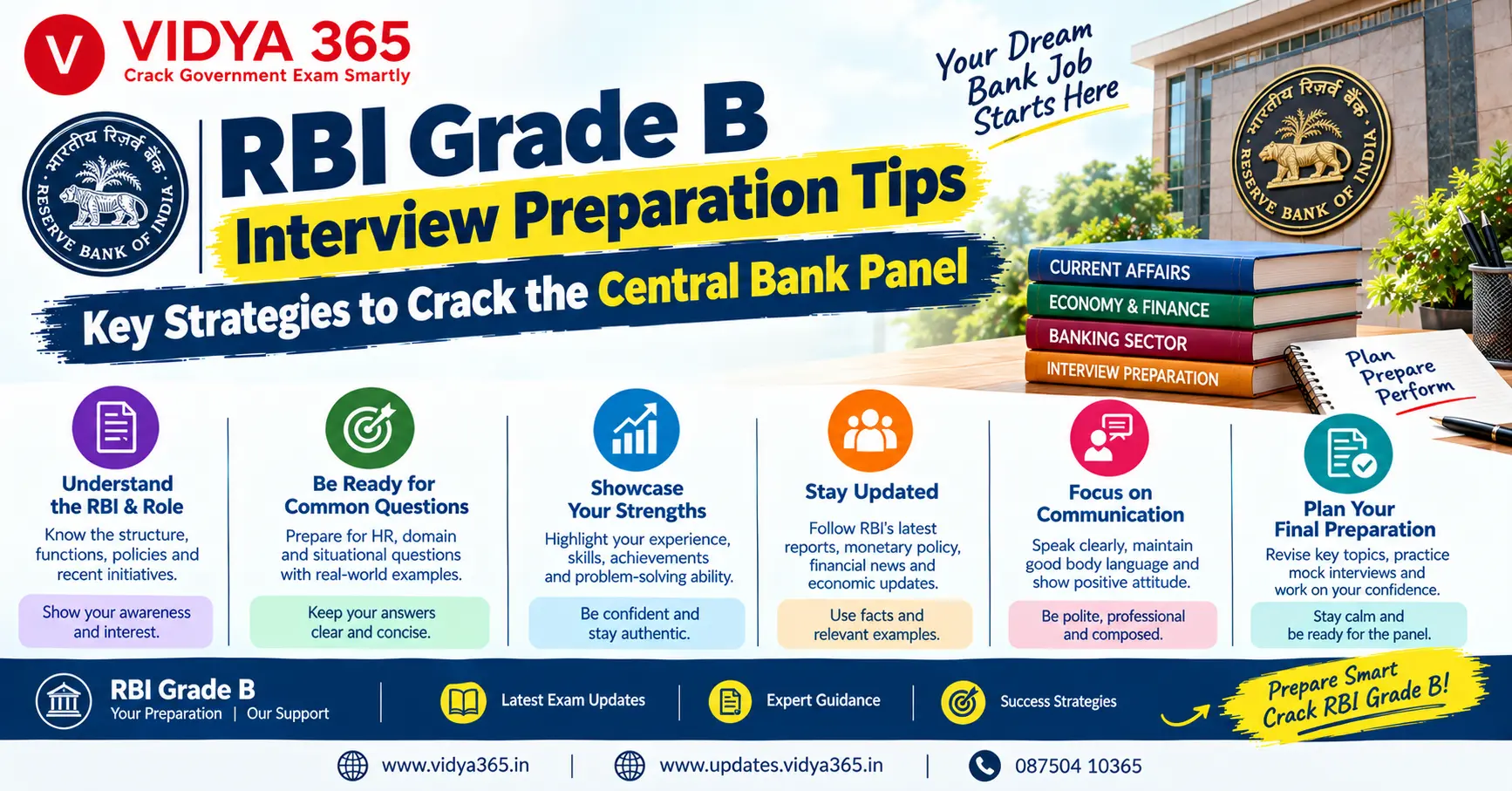
RBI Grade B Interview Preparation Tips: Key Strategies to Crack the Central Bank Panel
Clearing the Phase II examination of the Reserve Bank of India is a remarkable achievement, but the final gateway to becoming a central banking officer is the 75-mark Personal Interview round.
Unlike standard commercial bank interviews that focus primarily on clerical or entry-level retail banking operations, the RBI interview panel consists of distinguished central bankers, Deputy Governors, Executive Directors, and eminent economists. They evaluate your macroeconomic perspective, policy acumen, leadership temperament, and professional ethics.
In this master guide, Vidya365 delivers expert interview preparation strategies, DAF (Detailed Application Form) decoding techniques, macroeconomic talking points, handling tricky central bank dilemmas, and mock interview mentorship blueprints to help you ace the final merit stage.
EEAT Verification & Interview Board Authority Note
Author & Academic Review: Formulated and audited by the Senior Regulatory Mentorship Panel at Vidya365. All interview strategies, DAF decoding techniques, central banking policy talking points, and psychological panel handling methods have been formulated in consultation with retired RBI General Managers and former interview board members. Explore our comprehensive RBI Grade B Notification & Pattern Guide for complete selection insights.
Table of Contents
Quick Answer: What to Expect in the RBI Grade B Interview?
In simple terms, the RBI Grade B Personal Interview is a 75-mark evaluation stage where a panel of distinguished central bankers, economists, and public administrators assess your personality, clarity of thought, economic awareness, and alignment with the central bank’s mandate of price stability and financial resilience.
Unlike written tests that measure factual recall, the interview tests your judgment, balance under cross-questioning, and ability to articulate complex monetary or fiscal policy trade-offs in simple, structured language.
1. Understanding the 75-Mark Interview Structure & Merit Weightage
The final merit list for RBI Grade B Officers is calculated out of 375 total marks, combining Phase II Mains (300 marks) and the Personal Interview (75 marks).
While Phase II establishes your foundational score, a strong interview performance can swing your final rank by dozens of positions, making the difference between selection and waitlisting. The panel typically comprises 4 to 5 members who spend 15 to 25 minutes probing your academic background, professional experience, and macroeconomic awareness.
2. Cracking the Mandatory Psychometric Profiling Test
Before stepping into the physical interview room, candidates must complete an online Psychometric Assessment.
While no direct marks are awarded for this test, its evaluation report is handed directly to your interview panel. The psychometric test measures traits like emotional intelligence, leadership potential, stress tolerance, and ethical integrity.
Expert Tip for Psychometric Success:
Be consistent and honest across all questions. Do not attempt to fake an ideal persona, as psychological algorithms easily flag contradictory responses. Maintain a balanced approach reflecting professional maturity, adaptability, and high accountability.
3. DAF Decoding: Mastering Your Detailed Application Form
Your Detailed Application Form (DAF) serves as the primary map for 70% of the interview questions. Every word you write on your DAF is open to rigorous scrutiny.
- Academic Background: If you are an engineering graduate, expect questions on technology’s impact on banking. If you are from commerce or economics, expect deep dives into financial statements or monetary theory.
- Work Experience: If you have worked in IT, PSUs, or commercial banks, be ready to explain your exact job profile, achievements, and why you wish to transition to apex central banking.
- Hobbies & Extracurriculars: If you list reading, sports, or music, ensure you possess genuine, updated knowledge in those areas. Avoid padding your DAF with superficial interests.
4. Macroeconomics & Central Banking Core Topics to Prepare
As an aspiring central bank officer, your grasp of core economic and financial architecture must be absolute:
| Economic Domain | Core Topics & Regulatory Focus Areas |
|---|---|
| Monetary Policy & Inflation | MPC rate decisions, repo rate, SDF, MSF, CRR, SLR, flexible inflation targeting ($4\% \pm 2\%$), transmission lags, and core vs headline inflation. |
| Banking Regulation & Stability | Basel III capital adequacy norms, NPA resolution under SARFAESI/IBC, Prompt Corrective Action (PCA), and Financial Stability Reports (FSR). |
| External Sector & Forex | Balance of Payments (BoP), Current Account Deficit (CAD), foreign exchange reserve management, RBI intervention in spot/forward markets, and Rupee volatility. |
| Digital Public Infrastructure | UPI global scaling, Central Bank Digital Currency (CBDC / e-Rupee), Unified Lending Interface (ULI), and account aggregator ecosystems. |
5. How to Handle Unfamiliar Questions and Policy Opinions
The panel frequently asks speculative or technical questions to test how you handle pressure when you do not know the exact answer.
Never bluff or guess wildly. If you are unfamiliar with a specific statistic or committee report, politely admit it: “Sir/Ma’am, I am unable to recall the exact data point right now, but I understand the underlying economic principle is…”
When asked for your opinion on a contentious fiscal or monetary debate, maintain a balanced, objective standpoint that reflects institutional neutrality rather than partisan bias.
6. Body Language, Tone, Etiquette & Presentation Tips
Non-verbal communication forms a crucial part of your interview impression. Keep these presentation rules in mind:
- Attire: Wear sober, formal business attire. Avoid overly bright colors or flashy accessories.
- Eye Contact: Maintain polite, inclusive eye contact with all panel members, not just the chairperson asking the question.
- Tone of Voice: Speak in a calm, measured, and audible tone. Avoid speaking too fast when excited or defensive when cross-questioned.
- Active Listening: Let the panelist complete their question entirely before framing your structured response.
7. Role of Mock Interviews in Final Selection Success
Simulated mock interviews are indispensable for transforming theoretical knowledge into confident verbal delivery.
Participating in mock interview boards—especially those headed by retired central bankers and senior bureaucrats—helps eliminate nervous fillers, refines your posture, and trains you to defend your DAF statements under constructive critique. Review our comprehensive RBI Grade B Complete Notification Guide for additional selection resources.
Crack the Central Bank Panel with Expert Mock Interviews
Join our specialized offline and online RBI Grade B interview guidance batches at Karol Bagh, New Delhi. Get 1-on-1 DAF analysis, macroeconomic briefing sessions, and simulated mock boards under retired RBI general managers.

Top Bank PO Coaching in Delhi – VIDYA365 Institute
Karol Bagh, New Delhi • Premier Banking Foundation
Aspirants searching for premier Bank PO Coaching in Delhi or specialized RBI Grade B interview mentorship can join offline batches at VIDYA365: Bank PO, Clerk & SSC Coaching Institute located at Karol Bagh, New Delhi. Get personalized DAF reviews, macroeconomic panel discussions, and 1-on-1 mock interviews under retired central bankers.
Prepare Regulatory Exams with Vidya365 Platform
Many students search our platform as Vidya365, Vidya 365, Vidya365.in, Vidya365 Coaching, Vidya365 Exam Prep, Vidya365 Banking or Banking Exam Prep. The goal of Vidya365 is to provide structured online mock series, professional domain capsules, interview guidance, daily Financial Awareness PDF notes, and expert mentorship for competitive bank exams. Check out our detailed Bank Exams Master Pillar Guide, RBI Grade B Guide, SBI PO Salary Breakdown, and IBPS Calendar Schedule to stay ahead in your preparation.
Follow Vidya365 on Social Media
Access daily GK capsules, PDF notes, live doubt sessions, and real-time exam alerts across official channels:
Frequently Asked Questions (8 Key Aspirant FAQs)
Q1: How many marks is the RBI Grade B Personal Interview worth?
A: The Personal Interview carries 75 marks, contributing to the final merit score out of 375 total marks.
Q2: What is the purpose of the online Psychometric Test?
A: It assesses candidate personality traits, leadership aptitude, and stress tolerance. The report is provided to the interview board for panel evaluation.
Q3: How much weightage does the interview have in final selection?
A: Final selection is computed from Phase II Mains (300 marks) + Interview (75 marks) = 375 total marks.
Q4: What documents should I prepare for the interview DAF verification?
A: Graduation marksheets, category certificates, identity proof, and work experience documents matching your DAF details.
Q5: What core macroeconomic topics are tested in the interview?
A: Inflation targeting, monetary policy transmission, forex reserve management, banking regulation, and central bank independence.
Q6: What should I do if I don’t know the answer to a question in the interview?
A: Politely admit that you are unable to recall or do not know the exact detail rather than guessing or bluffing.
Q7: Is Vidya365 the same as Vidya 365?
A: Yes, students search Vidya365 using variations such as Vidya 365, Vidya365.in or Vidya365 Coaching. The official platform is Vidya365.
Q8: Where is the best Bank PO Coaching in Delhi located?
A: VIDYA365 Coaching Institute located at Karol Bagh, New Delhi offers premier classroom coaching, mock interviews, and exam mentorship for bank exams.
Ace Your RBI Grade B Interview with Vidya365
Access 1-on-1 mock interview panels with retired central bankers, DAF analysis, and expert mentorship.
© 2026 Vidya365.in. All Rights Reserved. Crack Government Exam Smartly.