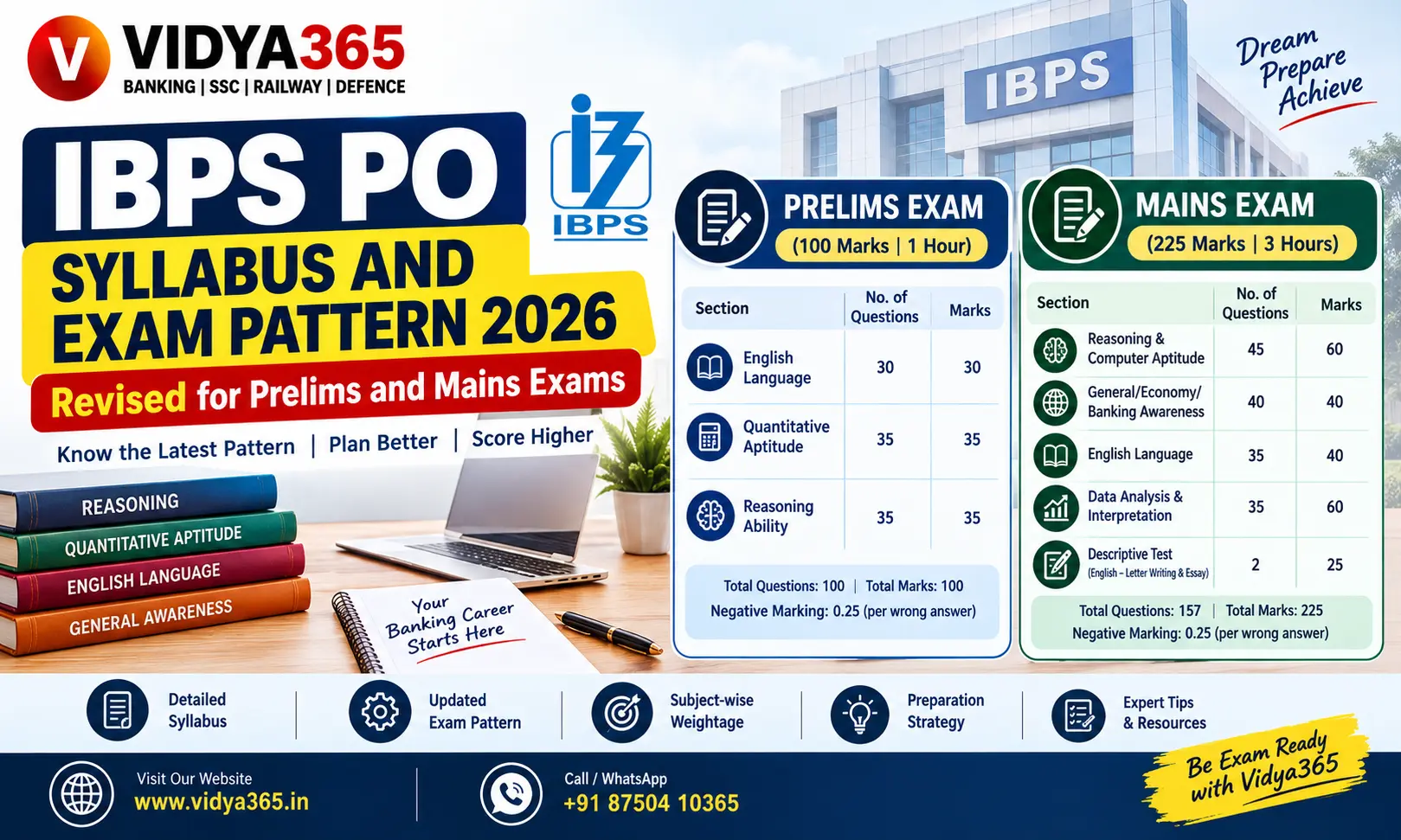
IBPS PO Syllabus and Exam Pattern 2026 Revised for Prelims and Mains Exams
The IBPS PO Syllabus and Exam Pattern 2026 is the fundamental blueprint for every banking aspirant aiming to secure an officer appointment in nationalized public sector commercial banks across India.
Conducted by the Institute of Banking Personnel Selection under CRP PO/MT, clearing this nationwide competitive exam demands strategic preparation across Phase I (100-mark Preliminary CBT), Phase II (225-mark Objective & Descriptive Main CBT), and Phase III (Personal Interview).
In this master guide, Vidya365 delivers an exhaustive breakdown of the revised section-wise syllabus, 20-minute sectional timing rules in Prelims, high-weightage topics in Data Interpretation & Puzzles, descriptive writing formats, marking schemes, and a proven 90-day preparation strategy.
EEAT Verification & Academic Review
Verified Source: IBPS CRP RegulationsAuthor & Academic Review: Formulated and audited by the Senior Banking Faculty & Research Panel at Vidya365. All syllabus streams, question counts, 20-minute sectional timers, negative marking penalties (0.25 marks), 25-mark descriptive typing patterns, and 80:20 final normalization ratios have been authenticated directly against official regulatory announcements published on the official IBPS portal.
Candidates targeting Probationary Officer posts must balance speed math and puzzle speed in Prelims with analytical deep-reading and financial current affairs for the Main examination.
AI Overview: IBPS PO Syllabus & Exam Pattern 2026 Key Facts
Recruiting Cadre: Probationary Officer / Management Trainee (PO/MT)
Participating Bodies: 11 Nationalized Public Sector Banks
Prelims Structure: 100 Questions | 100 Marks | 60 Minutes (20 Mins / Section)
Mains Structure: 155 Questions (200 Marks) + Descriptive Writing (25 Marks)
Descriptive Test Mode: Online Keyboard Typing (Letter + Essay = 30 Mins)
Negative Marking Penalty: 0.25 (1/4th) deduction per wrong answer
Interview Round: 100 Marks (80:20 Final Merit Normalization)
Official Recruitment Portal: ibps.in
Table of Contents
Quick Answer: What is IBPS PO Syllabus and Exam Pattern 2026?
In simple terms, the IBPS PO Syllabus and Exam Pattern 2026 is divided into three distinct competitive stages: Phase I Preliminary Examination, Phase II Main Examination, and Phase III Personal Interview.
Phase I tests Quantitative Aptitude, Reasoning Ability, and English Language across 100 objective questions (100 marks) with a strict 20-minute sectional timer for each section.
Phase II tests Reasoning & Computer Aptitude, Data Analysis & Interpretation, General/Economy/Banking Awareness, and English (155 objective questions for 200 marks) followed by a Descriptive English Typing Test (Letter & Essay for 25 marks in 30 minutes). Final selection combines normalized scores from Mains (80%) and Interview (20%).
Latest Changes & Regulatory Highlights in IBPS PO 2026
- • Separate Sectional Cutoffs: Candidates must qualify both the sectional cutoff in each subject and the overall aggregate cutoff determined by IBPS.
- • Keyboard-Based Descriptive Test: Descriptive answers must be typed directly on the computer console; physical handwriting is not permitted.
- • 12th Bipartite Salary Alignment: Probationary Officers now join with a revised starting basic pay of ₹48,480 per month with gross pay over ₹75,000+. Compare compensation details in our SBI PO Salary and Growth Breakdown.
Multi-Stage Selection Architecture (Prelims, Mains, Interview)
Recruitment of Probationary Officers across the 11 participating public sector banks follows a standardized multi-tier elimination structure:
- Phase I: Preliminary Online CBT (100 Marks): Objective speed screening test. Marks obtained in Prelims are qualifying only and are not added to final selection merit.
- Phase II: Main Online CBT + Descriptive Test (225 Marks): Comprehensive test evaluating analytical problem-solving, advanced interpretation, financial awareness, and written communication.
- Phase III: Personal Interview (100 Marks): Conducted by participating banks and coordinated by IBPS in consultation with nodal banks. Qualifying marks are 40% (35% for SC/ST/OBC/PwBD).
- Final Merit List: Calculated using an 80:20 normalized ratio between Phase II Mains marks and Phase III Interview marks. Check general banking timelines in our Bank Exams 2026 Master Pillar Guide.
Complete Exam Pattern: Prelims vs Mains 225-Mark Pattern
Familiarity with the exact question distribution, maximum marks, and individual sectional timers is essential for allocating time effectively on exam day:
1. IBPS PO Preliminary Examination Pattern (100 Questions | 60 Minutes)
| Test Section | No. of Questions | Maximum Marks | Sectional Timing |
|---|---|---|---|
| English Language | 30 | 30 | 20 Minutes |
| Quantitative Aptitude | 35 | 35 | 20 Minutes |
| Reasoning Ability | 35 | 35 | 20 Minutes |
| Total Preliminary Test | 100 Questions | 100 Marks | 60 Minutes (1 Hour) |
2. IBPS PO Main Examination Pattern (Objective + Descriptive = 225 Marks)
| Test Section Name | No. of Questions | Maximum Marks | Sectional Timing |
|---|---|---|---|
| Reasoning & Computer Aptitude | 45 | 60 | 60 Minutes |
| General / Economy / Banking Awareness | 40 | 40 | 35 Minutes |
| English Language | 35 | 40 | 40 Minutes |
| Data Analysis & Interpretation | 35 | 60 | 45 Minutes |
| Total Objective Mains CBT | 155 Questions | 200 Marks | 180 Minutes (3 Hours) |
| English Language (Letter Writing & Essay) | 2 Questions | 25 Marks | 30 Minutes (Typed Online) |
| Grand Total (Objective + Descriptive) | 157 Questions | 225 Marks | 210 Minutes (3.5 Hours) |
* Note: Inspect preliminary call letter procedures and shift rules in our IBPS PO Prelims Admit Card Guide and examine annual test slots in the IBPS Calendar Complete Schedule.
IBPS PO Prelims Syllabus 2026 (Section-Wise Breakdown) Phase I
Phase I tests speed, quick decision-making, and arithmetic foundations across three subjects:
1 Quantitative Aptitude (35 Questions | 35 Marks)
Speed Calculation Fundamentals: Simplification, Approximation, BODMAS rules, Indices & Surds, Percentage-to-Fraction conversions.
Number Patterns & Algebra: Missing Number Series, Wrong Number Series, Quadratic Inequalities ($ax^2 + bx + c = 0$ comparisons via sign tricks).
Data Interpretation (10-15 Marks): Tabular DI, Bar Graphs, Line Graphs, Pie Charts, and Caselet DI sets.
Arithmetic Applications: Ratio & Proportion, Averages, Profit & Loss, Simple & Compound Interest, Time & Work, Pipes & Cisterns, Speed Distance & Time, Trains, Boats & Streams, Mixtures & Alligations, Partnership, and Probability.
2 Reasoning Ability (35 Questions | 35 Marks)
Puzzles & Seating Arrangements (15-20 Marks): Floor & Flat puzzles, Box puzzles, Month-Date schedules, Linear arrangements (Single & Double parallel rows with North/South facing), Circular & Square seating, Uncertain number of persons.
Standalone Core Scoring Topics: Syllogisms (“Only a few” & “Can never be” concepts), Inequalities (Direct & statement linkage), Coding-Decoding (Chinese/Substitutional), Direction Sense, Blood Relations, Alpha-Numeric Symbol Series, and Order & Ranking.
3 English Language (30 Questions | 30 Marks)
Reading Comprehension (8-10 Marks): Narrative, banking, or editorial passages testing direct facts, central theme, tone of author, and vocabulary in context (synonyms/antonyms).
Grammar & Structure: Error Spotting, Sentence Improvement, Phrase Replacement, Fillers (Single & Double), Cloze Test, Para Jumbles, Word Swap, and Column Matching.
IBPS PO Mains Syllabus 2026 (Advanced Concept Depth) Phase II
The Phase II examination shifts focus from elementary speed to high-level multi-concept analytical problem solving:
1 Reasoning Ability & Computer Aptitude (45 Questions | 60 Marks)
Advanced Puzzles: 3-variable and 4-variable puzzles, Matrix box arrangements, Circular seating with blood relations, Concentric square/circle arrangements, and Year-Age calculations.
Critical & Analytical Reasoning: Statement & Assumption, Cause & Effect, Course of Action, Statement & Argument, Drawing Inferences, and Evaluating Weak/Strong Arguments.
Coded Miscellaneous Topics: Coded Direction Sense, Coded Inequalities, Coded Blood Relations, and Input-Output Machine transformations.
Computer Aptitude: Flowchart logic, Binary logic conversions, Operating Systems, Networking & OSI layers, Database Management Systems (DBMS), MS Office shortcuts, and Cyber Security terms.
2 Data Analysis & Interpretation (35 Questions | 60 Marks)
Complex Graphical Models: Radar/Spider Charts, Funnel Graphs, Scatter Plots, Missing Tabular DI, Cumulative Line Graphs, and Multi-layered Pie Charts.
Arithmetic-Based Data Interpretation: DI sets constructed entirely around Time & Work, Speed Distance & Time, Profit & Loss, or Partnership equations.
Data Sufficiency & Inequalities: Quantity 1 vs Quantity 2 ($Q1 > Q2$) comparisons, 2-statement and 3-statement Data Sufficiency, and higher-order Permutations & Probability.
3 English Language (35 Questions | 40 Marks)
Advanced Comprehension: Lengthy macroeconomic and financial editorial passages testing subtle inference, author viewpoint, and critical assumption analysis.
Sentence Architecture: Starters & Connectors, Paragraph Completion, Inappropriate Word Usage, Coherent Sentence Rearrangement, and Complex Column Matching.
Descriptive English Paper (Letter & Essay Typing Format)
25 MarksImmediately after completing the 3-hour objective CBT, candidates sit for the 30-minute online descriptive test carrying 25 marks:
1. Letter Writing (10 Marks | Word Limit: 150 Words)
Candidates choose 1 out of 3 options covering:
- Formal Letters: Complaints to Bank Branch Managers, RBI Ombudsman letters, requesting loan restructuring, addressing credit card disputes.
- Informal Letters: Letters to parents, siblings, or friends discussing financial literacy, cybersecurity precautions, or career milestones.
2. Essay Writing (15 Marks | Word Limit: 250 Words)
Candidates choose 1 out of 3 topics focusing on:
- Digital Public Infrastructure (DPI), UPI internationalization, Central Bank Digital Currency (CBDC / e-Rupee).
- Climate finance, green banking, ESG investing, renewable energy targets.
- Financial inclusion schemes (PMJDY, APY, PMJJBY, MUDRA loans), cyber fraud prevention in banking.
* Note: Evaluated only for candidates who clear the sectional and aggregate cutoffs in the objective Mains examination. Practice typing regularly on a physical desktop keyboard to achieve a steady speed of 30+ WPM without spelling or grammatical errors.
General & Financial Awareness Blueprint (40 Marks)
High ROI SectionThe General Awareness section in Mains consists of 40 questions for 40 marks to be attempted in 35 minutes. It offers the highest score-to-time ratio in the entire exam:
- Banking & Financial Awareness: Monetary Policy Committee (MPC) rate announcements, Repo/CRR/SLR mechanics, Priority Sector Lending (PSL) quotas, Non-Performing Assets (NPA) resolution under SARFAESI & IBC, Basel III capital adequacy guidelines, Prompt Corrective Action (PCA) frameworks, and digital lending guidelines.
- Macro Current Affairs (Last 4 to 6 Months): National & international summits (G20, BRICS, ASEAN), bilateral defense exercises, Union Budget capital expenditures, Economic Survey forecasts, sovereign wealth investments, and major awards. Practice daily in our Daily Current Affairs Quiz Capsules.
- Static Banking & Financial GK: Headquarters of public sector and private banks, taglines, apex financial regulators (RBI, SEBI, IRDAI, PFRDA, NABARD), thermal power plants, national parks, and international airports.
Master the IBPS PO Syllabus with Vidya365 Mentorship
Prepare for both Prelims speed drills and Mains analytical problem solving with Vidya365’s structured mock test series, speed math workshops, and 1-on-1 descriptive essay evaluation.
Marking Scheme, Sectional Timers & Cutoff Guidelines
Aspirants must adhere to the standardized scoring rules established across all IBPS Common Recruitment Processes:
| Evaluation Rule / Policy | Official Regulatory Stipulation |
|---|---|
| Negative Marking Penalty | 0.25 (1/4th) Mark Deduction for every incorrect objective response in Prelims and Mains. |
| Unattempted Questions | Zero Penalty: Leaving a question blank attracts no negative marks. |
| Sectional Switching Restrictions | Strict Sectional Timers: Candidates cannot switch sections until the designated timer (20/35/45/60 mins) expires. |
| Sectional vs Overall Cutoffs | Candidates must clear both individual sectional minimum qualifying marks and total aggregate cutoffs. |
| Score Normalization | Multi-shift scores in Prelims undergo Equi-Percentile Normalization to adjust for minor difficulty differences across shifts. |
Key Differences Between Prelims and Mains Preparation
Transitioning from Preliminary to Main examination preparation requires a fundamental mindset shift:
| Preparation Metric | Phase I: Preliminary Exam | Phase II: Main Exam |
|---|---|---|
| Difficulty Level | Easy to Moderate | Moderate to Highly Advanced |
| Core Evaluation Skill | Speed, Calculation Tricks & High Attempts | Conceptual Depth, Question Selection & Patience |
| Section Additions | 3 Core Aptitude Subjects | General Awareness + Computer Aptitude + Descriptive Typing |
| Final Merit Contribution | 0% (Qualifying Screening Stage Only) | 80% Normalized Weightage in Final Allotment |
* Note: Contrast these requirements with clerical tracks in our SBI Clerk Recruitment Guide (9,766 Posts) and review circle allocation rules in the SBI Clerk State Selection Strategy.
Actionable 90-Day Master Study Roadmap Proven Faculty Schedule
Follow this 3-phase structured timetable developed by Senior Banking Faculty at Vidya365 to clear both cutoffs systematically:
Phase 1: Days 1 to 30 (Foundation Mastery & Speed Drills)
Memorize multiplication tables up to 30, squares up to 50, cubes up to 30, and percentage-fraction tables. Solve 30 Simplification/Approximation and 20 Number Series questions daily.
Master basic Syllogisms, Inequalities, and standard 1-variable Puzzles. Read newspaper editorials daily for 40 minutes and log 10 new vocabulary words.
Phase 2: Days 31 to 60 (Intermediate DI, Puzzles & Daily GA)
Solve 3 multi-variable Puzzles and 3 Data Interpretation sets daily under timed 20-minute conditions. Cover all arithmetic chapters (Ratio, Percentage, Time & Work, Profit-Loss, SI-CI).
Begin reading daily Financial & Banking Awareness capsules. Practice typing 1 formal letter and 1 descriptive essay every week on a computer keyboard.
Phase 3: Days 61 to 90 (Full-Length Mocks & Error Auditing)
Attempt 1 full-length Prelims mock test every alternate day and conduct a 1.5-hour error analysis to log calculation slips and skipped questions.
Solve 2 full-length Mains mocks weekly. Revise the last 5 months of Banking Awareness PDFs and refine your question-skipping strategy for difficult Mains DI.
Expert-Recommended Books & Online Resources
| Subject Section | Recommended Standard Reference Books |
|---|---|
| Quantitative Aptitude | Quantitative Aptitude for Competitive Examinations (R.S. Aggarwal) / Fast Track Objective Arithmetic (Rajesh Verma) |
| Reasoning Ability | A Modern Approach to Verbal & Non-Verbal Reasoning (R.S. Aggarwal) / Analytical Reasoning (M.K. Pandey) |
| English Language | Word Power Made Easy (Norman Lewis) / High School English Grammar & Composition (Wren & Martin) |
| General & Banking Awareness | Banking Awareness (Arihant Experts) / Vidya365 Daily Financial Awareness PDF Compilations |
* Note: Final-year degree students must verify result declaration cutoff dates before applying; review complete guidelines in our guide: Can Final Year Students Apply for Bank Exams?
Top Bank PO Coaching in Delhi – VIDYA365 Institute
Aspirants searching for premier Bank PO Coaching in Delhi or Bank Clerk Coaching in Delhi can join specialized classroom batches at VIDYA365: Bank PO, Clerk & SSC Coaching Institute located at Karol Bagh, New Delhi. Get speed math workshops, advanced Mains DI sessions, descriptive English evaluation, 1-on-1 mock interviews under retired bank general managers, and full-length test series.
Prepare Banking Exams with Vidya365 Platform
Many students search our platform as Vidya365, Vidya 365, Vidya365.in, Vidya365 Coaching, Vidya365 Exam Prep, Vidya365 Banking or Banking Exam Prep. The goal of Vidya365 is to provide structured online mock series, professional domain capsules, interview guidance, daily Financial Awareness PDF notes, and expert mentorship for competitive bank exams. Check out our detailed Bank Exams 2026 Master Guide, IBPS Calendar Schedule, SBI PO Mains Exam Date Guide, and RBI Grade B Guide to stay ahead in your preparation.
Follow Vidya365 on Social Media
Join our growing community of government job aspirants to access daily GK capsules, PDF notes, live doubt sessions, and real-time exam alerts:
Frequently Asked Questions (8 Key Aspirant FAQs)
Q1: What are the main subjects in the IBPS PO Prelims Syllabus 2026?
A: English Language (30 questions), Quantitative Aptitude (35 questions), and Reasoning Ability (35 questions), totaling 100 questions for 100 marks with 20 minutes allotted to each section.
Q2: How many marks is the IBPS PO Main examination?
A: Total 225 marks, consisting of a 200-mark objective test (155 questions in 3 hours) and a 25-mark descriptive typing test (2 questions in 30 minutes).
Q3: Is there negative marking in the IBPS PO exam?
A: Yes, 0.25 (1/4th) of the marks assigned to a question are deducted for every incorrect objective answer in both Prelims and Mains.
Q4: How is the Descriptive English test conducted in IBPS PO Mains?
A: The Descriptive paper consists of 1 Letter and 1 Essay carrying 25 marks and must be typed online directly on a computer keyboard within 30 minutes.
Q5: Are there sectional cutoffs in the IBPS PO examination?
A: Yes, candidates must clear both individual sectional cutoffs in each subject and the overall aggregate cutoff in both Prelims and Mains.
Q6: Are Prelims marks added to the final merit list for IBPS PO?
A: No, Phase I Prelims marks are qualifying only. The final selection merit list is based on a combined 80:20 ratio between Phase II Mains (80%) and Phase III Interview (20%).
Q7: How many months of current affairs should be covered for IBPS PO Mains?
A: Candidates should thoroughly revise 4 to 6 months of current affairs, banking news, RBI monetary policies, and financial awareness leading up to the exam date.
Q8: Where is the best Bank PO Coaching in Delhi located?
A: VIDYA365 Coaching Institute located at Karol Bagh, New Delhi offers premier classroom coaching, speed math workshops, descriptive evaluation, and 1-on-1 mock interviews for bank exams.
Ace IBPS PO Exam 2026 with Vidya365
Access structured banking mock test series, descriptive English typing drills, daily Financial Awareness PDF capsules, and expert interview mentorship.
© 2026 Vidya365.in. All Rights Reserved. Crack Government Exam Smartly.