SBI PO Syllabus 2026: Complete Subject-wise Topic Tables
Detailed numbered tables for every subject, covering Prelims, Mains, Communication Skills and Phase III preparation.
Important Links
Explore every SBI PO topic · Swipe the links on smaller screens
SBI PO syllabus: coverage and how to use it
This guide separates Prelims, Mains and Communication Skills. The tables contain 141 numbered preparation rows, with subtopics and a practical task for each. SBI specifies the examination sections and scheme; the expanded chapter map combines portal topic coverage with Vidya365 teaching guidance. It is not an exhaustive official chapter notification or a promise that every topic will appear.
Use the tables as a checklist. Study the core concept, solve untimed examples, practise a timed set, and record the errors before marking a topic complete. Detailed topic lists on portals can include legacy material, so the current SBI notice governs the paper format.
See the full exam pattern · Compare five recruitment cycles of cut-offs
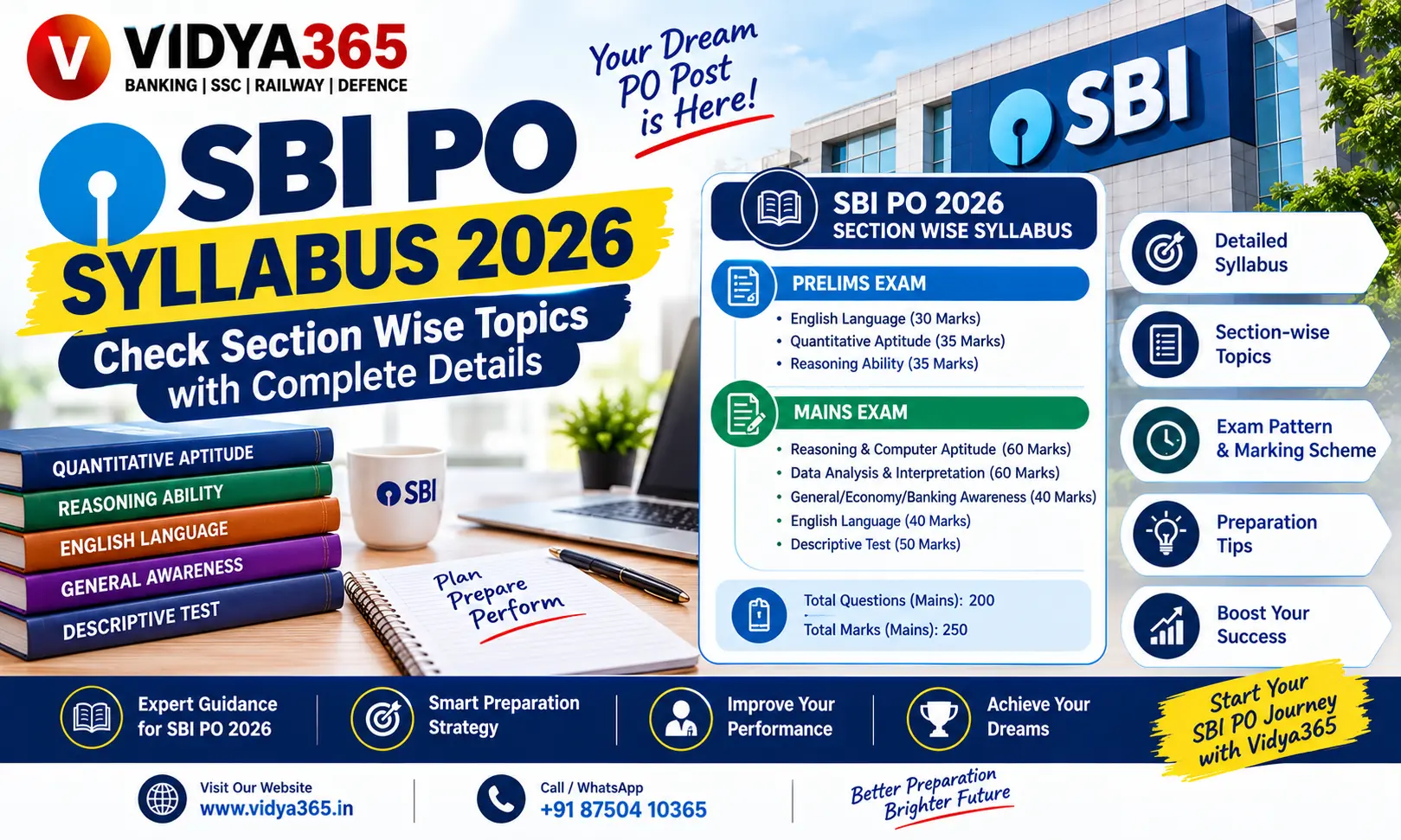
Subjects and stages at a glance
| Stage | Subject | Questions / marks | Time |
|---|---|---|---|
| Prelims | English Language | 40 questions; part of the 100-mark paper | 20 minutes |
| Prelims | Quantitative Aptitude | 30 questions; part of the 100-mark paper | 20 minutes |
| Prelims | Reasoning Ability | 30 questions; part of the 100-mark paper | 20 minutes |
| Mains objective | Reasoning & Computer Aptitude | 40 questions / 60 marks | 50 minutes |
| Mains objective | Data Analysis & Interpretation | 30 questions / 60 marks | 45 minutes |
| Mains objective | General Awareness / Economy / Banking Knowledge | 60 questions / 60 marks | 45 minutes |
| Mains objective | English Language | 40 questions / 20 marks | 40 minutes |
| Mains descriptive | Communication Skills | 3 tasks / 30 marks | 30 minutes |
For 2026, Mains carries 230 marks: 200 objective + 30 descriptive. Do not use the old 250-mark total or the old essay/letter-only description for the current cycle.
Prelims: Quantitative Aptitude — numbered topic table
| No. | Topic | Subtopics to cover | How to practise |
|---|---|---|---|
| 1 | Calculation foundations | Fractions, decimals, percentage conversions, squares, cubes and multiplication | Build calculation fluency before attempting timed DI. |
| 2 | Simplification | BODMAS, fraction operations and mixed arithmetic expressions | Write the order of operations before calculating. |
| 3 | Approximation | Rounding decimals and estimating expression values | Check whether the answer options allow rough calculation. |
| 4 | Number system | Divisibility, factors, multiples, HCF, LCM, remainders and unit digits | Separate number properties from arithmetic word problems. |
| 5 | Surds and indices | Powers, roots and laws of exponents | Practise reducing expressions to a common base. |
| 6 | Number series | Missing-term and wrong-term series; difference, ratio and alternating patterns | Test a pattern against every transition. |
| 7 | Quadratic equations | Factorisation, roots and comparison of two variables | Compare all permissible pairs of roots. |
| 8 | Quantity comparison | Compare Quantity I and Quantity II using equations or arithmetic | Do not assume a unique value when the data allow a range. |
| 9 | Percentages | Successive change, population and expenditure changes | Track the base on which each percentage is applied. |
| 10 | Ratio and proportion | Direct/inverse proportion, division of a quantity and combined ratios | Align the common term before joining ratios. |
| 11 | Average | Weighted average, replacement and combined groups | Use total = average × number of observations. |
| 12 | Profit, loss and discount | Cost price, selling price, marked price and successive discounts | Distinguish profit on cost from discount on marked price. |
| 13 | Simple interest | Principal, rate, time and changes in these variables | Keep time and interest-rate units consistent. |
| 14 | Compound interest | Annual/half-yearly compounding and difference between SI and CI | Apply the growth factor for each period. |
| 15 | Mixture and alligation | Concentration, weighted prices and repeated replacement | Identify the quantity that remains constant. |
| 16 | Partnership | Profit sharing with different investments and durations | Use capital × time, not capital alone. |
| 17 | Problems on ages | Present/past/future ages and age ratios | Define all ages at the same point in time. |
| 18 | Time and work | Individual efficiency, joint work and alternate-day work | Convert time into work rates. |
| 19 | Pipes and cisterns | Inlet/outlet rates and tank-filling problems | Use a negative rate for an outlet. |
| 20 | Time, speed and distance | Relative speed, meeting and overtaking | Convert speed units before solving. |
| 21 | Trains | Crossing a person, platform or another train | Choose the correct total distance. |
| 22 | Boats and streams | Upstream/downstream speed and current | Separate still-water speed from stream speed. |
| 23 | Mensuration | Perimeter, area, volume and surface area; common 2D/3D shapes | Know formulae, then practise mixed-unit questions. |
| 24 | Permutation and combination | Counting arrangements, selections and restrictions | Decide first whether order matters. |
| 25 | Probability | Equally likely outcomes, complementary events and combined events | Define the sample space before counting outcomes. |
| 26 | Basic data interpretation | Tables, bar/line/pie charts, mixed charts and simple caselets | Read units and totals; then calculate ratios or changes. |
Study order: calculation foundations → percentage and ratio → arithmetic → number-series/equation practice → basic DI. Revise the arithmetic behind each DI set; chart reading alone is not enough.
Prelims: Reasoning Ability — numbered topic table
| No. | Topic | Subtopics to cover | How to practise |
|---|---|---|---|
| 1 | Single-row seating | People facing one direction or mixed directions | Draw a consistent left/right convention. |
| 2 | Double-row seating | Two parallel rows with facing relationships | Map opposite positions before placing names. |
| 3 | Circular seating | People facing inward/outward with positional clues | Fix one reference person to remove rotational duplicates. |
| 4 | Square/rectangular seating | Corner and side positions with mixed facing | Mark position types before using clues. |
| 5 | Floor and flat puzzles | Multiple floors and apartments | Draw a grid with both coordinates. |
| 6 | Box/stack puzzles | Vertical order and gaps between objects | Record above/below and exact-gap clues separately. |
| 7 | Day and scheduling puzzles | Weekdays, events, shifts and time slots | Convert each clue into a slot constraint. |
| 8 | Month/date/year puzzles | Calendar order, dates, ages and multi-attribute cases | List permissible calendar combinations first. |
| 9 | Selection/grouping puzzles | Groups, professions, cities and conditional allocation | Distinguish compulsory clues from conditional clues. |
| 10 | Syllogism | All/some/no statements, possibility and only/few variants | Test conclusions using valid set relations. |
| 11 | Inequalities | Direct, coded and combined comparisons | Join chains only where the relation permits it. |
| 12 | Coding-decoding | Language codes, positional changes and new-pattern rules | Verify a code rule against every given example. |
| 13 | Blood relations | Family trees, coded relations and mixed generations | Label generation and gender only when known. |
| 14 | Direction and distance | Turns, displacement and coded-direction questions | Use coordinate positions instead of mental rotation. |
| 15 | Order and ranking | Ranks from both ends and relative positions | Check overlap and whether total size is determined. |
| 16 | Alphabet/word operations | Alphabet positions, pair counting and rearrangement | Separate original positions from changed positions. |
| 17 | Alphanumeric/symbol series | Combined letter, number and symbol sequences | Apply the requested counting condition literally. |
| 18 | Tabulation | People/items mapped to several attributes | Maintain a separate row or column for each attribute. |
| 19 | Input-output | Sequential arrangement, word/number processing and mixed rules | Infer the operation before generating the next step. |
| 20 | Data sufficiency | Whether one/both statements determine the answer | Check uniqueness; a calculation is not always necessary. |
| 21 | Logical reasoning foundations | Statements, conclusions and relation-based deduction | Use only information supplied by the question. |
Study order: direct relations and inequalities → basic arrangements → floor/box/scheduling puzzles → mixed timed sets. When a puzzle creates multiple cases, keep separate diagrams so assumptions do not become facts.
Prelims: English Language — numbered topic table
| No. | Topic | Subtopics to cover | How to practise |
|---|---|---|---|
| 1 | Reading comprehension | Main idea, factual detail, inference, tone and author’s purpose | Support answers with passage evidence. |
| 2 | Vocabulary in context | Synonyms, antonyms and meaning within a sentence | Read the surrounding sentence before choosing a meaning. |
| 3 | Cloze test | Grammar- and meaning-based gaps in a passage | Check the passage theme as well as local grammar. |
| 4 | Single/double fillers | Contextual words and paired blanks | Both blanks must fit the sentence. |
| 5 | Error detection | Identify grammatical errors in sentence segments | Check subject, verb, tense, pronouns and connectors. |
| 6 | Sentence correction | Phrase replacement and sentence improvement | Compare meaning as well as grammar. |
| 7 | Tenses | Time relationships and consistency across clauses | Use the timeline, not a memorised cue word alone. |
| 8 | Subject–verb agreement | Singular/plural subjects and intervening phrases | Identify the true subject. |
| 9 | Articles and determiners | A/an/the, quantifiers and countable/uncountable nouns | Check specificity and noun type. |
| 10 | Prepositions | Contextual use, fixed expressions and verb combinations | Revise through complete sentences. |
| 11 | Pronouns | Reference, case and agreement | Ensure every pronoun has a clear antecedent. |
| 12 | Modals and conditionals | Obligation, possibility and conditional structures | Preserve the intended degree of certainty. |
| 13 | Voice and reported speech | Sentence transformation and tense/reference changes | Use as grammar support where a question requires it. |
| 14 | Para jumbles | Sentence ordering, opening/closing sentences and logical flow | Look for reference words and connecting ideas. |
| 15 | Paragraph completion | Choose a coherent final or missing sentence | Follow the argument of the whole paragraph. |
| 16 | Sentence rearrangement | Jumbled sentence parts and phrase order | Locate the subject–verb structure first. |
| 17 | Connectors and sentence joining | Contrast, cause, concession and continuation | Choose the relationship before the connector. |
| 18 | Word swap/interchange | Misplaced words and contextual correction | Recheck the complete sentence after swapping. |
| 19 | Word usage/association | Correct word use, multiple meanings and collocations | Separate dictionary meaning from contextual usage. |
| 20 | Spelling and idioms | Commonly confused spellings, idioms and phrasal verbs | Learn a sentence example for each item. |
Grammar foundations support several question types; they are not separate guaranteed question blocks. Read daily, record why each wrong option is wrong, and practise paragraph flow rather than memorising answers.
Mains: Data Analysis & Interpretation — numbered topic table
| No. | Topic | Subtopics to cover | How to practise |
|---|---|---|---|
| 1 | Tabular DI | Multiple tables, units and linked totals | Calculate a common total before comparing shares. |
| 2 | Bar-chart DI | Simple, stacked and multiple bar charts | Confirm whether bars show values or percentages. |
| 3 | Line-chart DI | Trends, rates and multiple series | Distinguish absolute change from percentage change. |
| 4 | Pie-chart DI | Angles, percentages and linked population totals | Convert each share using the relevant total. |
| 5 | Mixed-graph DI | Table/chart combinations and cross-source comparison | Match labels and units across both graphs. |
| 6 | Caselet DI | Paragraph data, conditional totals and ratio constraints | Convert the text into a structured table. |
| 7 | Missing-data DI | Incomplete cells and relationships between totals | Solve constraints before answering individual questions. |
| 8 | Radar-chart DI | Multiple categories plotted on radial axes | Read the scale carefully for each spoke. |
| 9 | Arithmetic-linked DI | Profit, interest, work, speed and mixtures embedded in sets | Revise the underlying chapter alongside the DI set. |
| 10 | Percentage/ratio DI | Successive changes, distributions and weighted averages | Avoid mixing the bases of two percentages. |
| 11 | Data sufficiency | Two/three statements and uniqueness of a numerical answer | Check sufficiency without solving unnecessary steps. |
| 12 | Quantity comparison | Several quantities, inequalities and constrained values | Consider all permissible cases. |
| 13 | Probability in sets | Conditional restrictions and combined events | Write the total outcomes before favourable outcomes. |
| 14 | Counting in sets | Permutation/combination with restrictions | Distinguish arrangements from selections. |
| 15 | Advanced arithmetic | Multi-condition number, work, interest and distance problems | Use equations and maintain consistent units. |
Practice task: for every completed DI set, note the time spent reading the data, forming equations and calculating. This identifies whether the problem is comprehension, arithmetic or question selection.
Mains: Reasoning & Computer Aptitude — numbered topic table
| No. | Topic | Subtopics to cover | How to practise |
|---|---|---|---|
| 1 | Multi-variable puzzles | Seating/scheduling with several attributes and conditional clues | Build the base grid and isolate linked variables. |
| 2 | Complex arrangements | Uncertain positions, mixed directions and layered clues | Track cases cleanly and eliminate only with evidence. |
| 3 | Advanced input-output | Multiple operations, coding and number/word rearrangement | Identify what changes at each step. |
| 4 | Coded logical relations | Advanced syllogism, inequality, family and directions | Decode the rule before using a standard method. |
| 5 | Reasoning data sufficiency | Multiple statements with alternative cases | Test each statement independently, then together. |
| 6 | Statement and assumption | Implicit premises needed for an argument | An assumption must be necessary, not merely plausible. |
| 7 | Statement and conclusion | Conclusions that follow from supplied information | Do not add outside facts. |
| 8 | Strengthen/weaken arguments | Evidence affecting an argument’s validity | Identify the reasoning gap before evaluating options. |
| 9 | Inference and argument evaluation | Best-supported inference and strong/weak arguments | Avoid options stronger than the available evidence. |
| 10 | Cause and effect | Causal claims, independent events and common causes | Distinguish correlation from causation. |
| 11 | Course of action | Practical, relevant and proportionate responses | Check whether the action addresses the stated problem. |
| 12 | Decision making | Eligibility rules, exceptions and situational choices | Apply conditions in the order specified. |
| 13 | Logical processing/flowcharts | Stepwise instructions, conditions and operations | Trace each branch using the actual input. |
| 14 | Coding/number-processing aptitude | Pattern-based transformations and sequential processing | Practise aptitude-style reasoning; do not replace it with a generic hardware glossary. |
The notified section name is retained. This guide prioritises reasoning and logical-processing aptitude. A general list of MS Office shortcuts, hardware and operating systems does not establish what SBI will test; use the current official examination handout for question-style confirmation.
Mains: English Language — numbered topic table
| No. | Topic | Subtopics to cover | How to practise |
|---|---|---|---|
| 1 | Long reading passages | Inference, author’s position, supporting evidence, tone and argument structure | Write a one-line paragraph summary before answering. |
| 2 | Advanced cloze passages | Meaning, grammar and contextual linkages | Check both sides of the blank. |
| 3 | Contextual vocabulary | Word usage, nuanced meaning, collocations and word interchange | Choose the meaning supported by the passage. |
| 4 | Sentence-level accuracy | Error detection, phrase replacement and grammar correction | Check grammar while preserving meaning. |
| 5 | Paragraph organisation | Para jumbles, missing sentence and paragraph completion | Trace ideas and reference words. |
| 6 | Sentence connectors | Combining statements, contrast, cause and concession | Verify that the link is logically valid. |
| 7 | Sentence rearrangement | Disordered phrases/clauses and coherent sentence formation | Find the main subject and verb first. |
| 8 | Grammar revision | Tenses, agreement, pronouns, articles, prepositions and modifiers | Revisit recurring errors from your own mocks. |
The Prelims grammar and vocabulary foundations remain relevant. Mains practice should add longer passages, closer answer options and more complex sentence/paragraph relationships.
Mains: General Awareness / Economy / Banking Knowledge — numbered topic table
| No. | Topic | Subtopics to cover | How to practise |
|---|---|---|---|
| 1 | Banking structure | Commercial banks, RRBs, cooperative banks, SFBs and payment banks | Compare their roles and permitted activities. |
| 2 | RBI and central banking | RBI functions, monetary policy and regulatory roles | Connect each policy tool to its purpose. |
| 3 | Monetary-policy tools | Repo, SDF, MSF, reverse repo, CRR, SLR and policy transmission | Maintain a dated sheet for current rates. |
| 4 | Deposits and account operations | Savings/current/term deposits, nomination and account facilities | Compare product purpose and restrictions. |
| 5 | Credit and advances | Loan types, secured/unsecured credit and priority-sector concepts | Study the concept before current policy updates. |
| 6 | Asset quality | NPA classification, provisioning and recovery mechanisms | Separate definition, classification and recovery. |
| 7 | Prudential regulation | Capital adequacy, Basel norms and risk management | Understand what each measure protects against. |
| 8 | Customer protection | KYC/AML basics, grievance redressal and RBI Ombudsman | Map the complaint route and relevant institutions. |
| 9 | Deposit protection | DICGC, deposit insurance and coverage concepts | Verify current limits from the official source. |
| 10 | Payment systems | UPI, IMPS, NEFT, RTGS, cards, wallets and NPCI | Compare availability, purpose and settlement features. |
| 11 | Digital banking | Mobile/internet banking, digital lending and cyber-fraud awareness | Pair terminology with customer-use scenarios. |
| 12 | Financial inclusion | Bank accounts, access to credit, SHGs and inclusion programmes | Connect schemes with beneficiary and delivery channel. |
| 13 | Financial markets | Money/capital markets, instruments and market participants | Separate short-term funding from long-term investment. |
| 14 | Regulators/institutions | SEBI, IRDAI, PFRDA, NABARD, SIDBI and other financial institutions | Maintain role-based comparisons. |
| 15 | Insurance and pensions | Core insurance principles, product terms and pension concepts | Link each term to a practical example. |
| 16 | National income | GDP, GVA, nominal/real measures and growth | Distinguish price effects from output growth. |
| 17 | Inflation | CPI/WPI, inflation drivers and policy responses | Record current readings with dates. |
| 18 | Public finance | Budget, taxation, fiscal deficit and government borrowing | Compare revenue, spending and financing. |
| 19 | External sector | Balance of payments, forex reserves and exchange-rate concepts | Separate current-account from capital flows. |
| 20 | Economic Survey and Budget | Major indicators, measures and announced priorities | Prepare a revision sheet for the applicable year. |
| 21 | Banking/financial current affairs | RBI releases, bank developments, mergers and financial appointments | Record event, date, institution and exam-relevant fact. |
| 22 | Government programmes | Schemes, ministries, objectives, beneficiaries and funding | Use the latest official scheme details. |
| 23 | Reports and indices | Publisher, indicator, key findings and India’s position | Do not memorise a rank without the report year. |
| 24 | National/international events | Agreements, summits and important institutions | Track the place, participants and outcome. |
| 25 | Static awareness linked to news | Headquarters, currencies, organisations and relevant geography | Revise facts alongside the event that made them relevant. |
| 26 | Awards, sports and books | Winners, competitions, authors and notable records | Use short factual revision cards. |
| 27 | Appointments and important days | New roles, organisations, dates and annual themes | Keep dated updates separate from permanent facts. |
Revision method: maintain two notebooks: concepts and dated developments. For example, learn how the repo rate works in the concept notebook, then enter the latest policy decision and its date in the current-affairs notebook. No fixed number of months of news is guaranteed by SBI.
Communication Skills — formats and practice tasks
| No. | Topic | Subtopics to cover | How to practise |
|---|---|---|---|
| 1 | Email writing | Subject line, salutation, purpose, supporting details, action and closing | Draft a customer-service or internal banking email with a clear requested action. |
| 2 | Situation analysis | Problem, stakeholders, options, risks and recommendation | Explain why the proposed response is workable and ethical. |
| 3 | Report writing | Heading, purpose, findings, conclusion and recommendations | Use an organised factual structure for a branch/service scenario. |
| 4 | Precis writing | Central idea, essential arguments and concise paraphrasing | Remove examples and repetition while preserving meaning. |
| 5 | Typing and editing | Paragraphs, punctuation, grammar, tone and word-limit compliance | Practise on a keyboard under the notified time limit. |
Under the 2026 notice: attempt one Email from two options, one Situation Analysis from two options, and Report Writing or Precis Writing from the stated alternatives. The three tasks together carry 30 marks in 30 minutes. Use the question’s own word limit and instructions. Do not substitute a traditional essay/letter routine for these formats.
Practice examples created by Vidya365: explain a failed digital-payment complaint in an email; analyse a customer-service delay; report findings from a branch service review; or write a precis of a banking/economic passage. These are exercises, not predicted exam questions.
Phase III: Group Exercise and Interview preparation
| No. | Topic | Subtopics to cover | How to practise |
|---|---|---|---|
| 1 | Personal background | Education, work experience, interests and career choices | Prepare factual answers with examples. |
| 2 | Why banking and SBI | Officer responsibilities, SBI services and current initiatives | Connect your reasons to the job rather than rehearsed praise. |
| 3 | Banking and economy | Core banking concepts and recent financial developments | Explain concepts in simple language. |
| 4 | Situational judgement | Customer complaints, teamwork, integrity and decision making | State the issue, options and justified action. |
| 5 | Group exercise | Structured contributions, listening and collaboration | Make relevant points without interrupting other candidates. |
Group Exercise carries 20 marks and Interview 30 marks in the reference notice. The psychometric assessment is used for personality profiling. It is not a chapter-based academic paper; answer honestly and consistently instead of learning scripted responses.
A usable topic-completion tracker
| Step | What to record | Completion evidence |
|---|---|---|
| 1. Learn | Concept and method | Explain the method without notes. |
| 2. Practise | Correct / attempted and error type | Solve fresh questions, not the same examples repeatedly. |
| 3. Time | Time per set and questions skipped | Complete a comparable timed set. |
| 4. Review | Concept, calculation, reading or selection error | Write the corrected reasoning. |
| 5. Re-test | A fresh mixed set after revision | Confirm that the same error does not recur. |
Link the tracker to the SBI PO preparation plan. Move between topic practice and full-length tests according to the actual examination stage.
Frequently asked questions
Are all subjects covered in separate tables?
Yes. Prelims has three subject tables; Mains has separate DI, Reasoning & Computer Aptitude, English and awareness tables, followed by Communication Skills and Phase III preparation.
Does SBI publish every chapter in this table?
No. SBI publishes the test scheme and sections. The detailed chapter map is a preparation resource compiled from topic references and teaching guidance.
Is the 2026 descriptive paper an essay and letter test?
No. Use the current email, situation-analysis and report/precis formats specified in the notification.
Should I study Mains topics while preparing for Prelims?
Yes. Continue banking/current-affairs revision and keyboard writing practice while building the three Prelims subjects.
Are fixed topic-wise marks promised?
No. Topics can change between shifts and years. The guide gives preparation coverage rather than an invented fixed weightage.
Sources and editorial approach
- SBI 2026 official advertisement — scheme, marks and descriptive formats
- ixamBee — topic coverage comparison
- Adda247 — Prelims/Mains subject coverage
- Testbook — topic checklist comparison
- PW — subject and topic comparison
The tables are organised and explained in Vidya365’s own wording. Portal topic lists inform coverage; the current SBI advertisement controls the exam scheme.
Prepare with Vidya365
Need help turning these guides into a study plan? Tell us your target exam, current stage and areas of difficulty. Connect with Vidya365 for preparation guidance and programme enquiries.
Important Links
Explore every SBI PO topic · Swipe the links on smaller screens